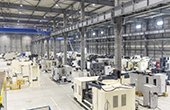
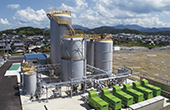
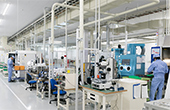
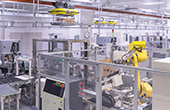
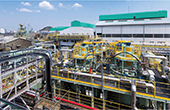
Walking through the gate, my eyes are immediately drawn to the landscaping at the entrance, shaped to spell out the word “DUNLOP.” This is Sumitomo Rubber Industries’ Shirakawa Factory. Opened in 1974, it is Japan’s largest tire manufacturing facility, producing more than 10,000 tons of tires per month (rubber volume basis) for vehicles ranging from compact cars to heavy-duty trucks. “As part of our efforts toward carbon neutrality, we are manufacturing tires using hydrogen energy,” says Mr. Nobuaki Nakata, who oversees the hydrogen project in the Environmental Strategy Promotion Department.
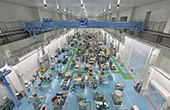
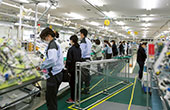
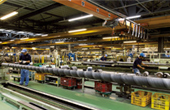
Tire manufacturing is generally divided into six main processes: “mixing,” in which raw rubber, carbon, and chemicals are blended together; “component preparation,” in which tire components are produced; “tire building,” in which the components are assembled to form the basic structure of the tire; “vulcanization,” in which heat and pressure trigger a chemical reaction that gives the tire its strong elasticity; followed by “inspection” and “shipment.” Of these processes, mixing, component preparation, and tire building consume electricity, but decarbonization can be achieved through energy conservation and use of renewable energy. On the other hand, vulcanization requires high-pressure steam at temperatures reaching 200°C. Because generating such steam using electricity has been technically difficult, natural gas has traditionally been used as the fuel source. “CO2 emissions were unavoidable, making this the greatest challenge in achieving carbon neutrality in tire manufacturing,” explains Mr. Nakata.
Since around 2010, Sumitomo Rubber Industries has explored various energy-conversion methods, including electric and microwave heating, with the aim of decarbonizing its factories. Around 2020, hydrogen emerged as a promising option. Hydrogen can be extracted from water using electricity and can also be produced from a variety of resources. Moreover, when used as a heat source through combustion, it emits no CO2.
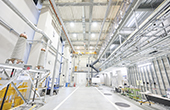
Another major advantage of hydrogen, Mr. Nakata explains, is that “if steam is generated by combusting hydrogen, existing facilities and manufacturing expertise cultivated over many years can continue to be utilized, with the exception of the boiler used as the heat source.” The fact that the Shirakawa Factory is located in Fukushima Prefecture has also helped advance hydrogen utilization at the site. Under its Fukushima Plan for a New Energy Society, Fukushima Prefecture has become a leader in renewable energy, with renewable sources currently accounting for more than 40% of the prefecture’s total energy mix. The prefecture is home to FH2R, one of the world’s largest facilities for producing green hydrogen derived from renewable energy, as well as hydrogen supply bases in three neighboring municipalities.
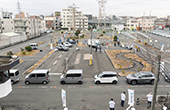
“While research on the supply side of hydrogen has been advancing, there have been very few demonstration projects on the demand side that actually utilize hydrogen. So we sought cooperation from local government authorities and hydrogen suppliers,” says Mr. Nakata. In August 2021, the project was selected for a grant program by the New Energy and Industrial Technology Development Organization (NEDO), and demonstration testing using hydrogen boilers was conducted through March 2024. Sumitomo Rubber Industries established a system for procuring hydrogen from production facilities in Fukushima Prefecture, transporting it in hydrogen trailers whose tanks are decorated with images of Nan Lake and Komine Castle—symbols of Shirakawa City—and receiving it at the Shirakawa Factory. Following the development of a high-pressure hydrogen boiler, to replace conventional liquefied natural gas systems, the company generated high-temperature, high-pressure steam using hydrogen and applied the resulting energy to tire manufacturing. In addition, 2MW solar panels were installed in the employee parking area. In January 2023, the company became the first in Japan to begin producing tires using hydrogen energy and solar power to achieve carbon neutrality during manufacturing.
Based on the results of these demonstration tests, as well as challenges related to the stable supply and cost of hydrogen, the company decided in May 2024 to introduce the “Yamanashi Model P2G System,” a next-generation energy system whose development has been led by Yamanashi Prefecture. The system uses renewable energy sources such as solar power to electrolyze water and produce environmentally friendly green hydrogen. In April 2025, as part of a NEDO demonstration project, the company began operating hydrogen production equipment employing the P2G system.
“We have been working to address issues such as ensuring a steady supply of hydrogen for the 24-hour continuous operation of hydrogen boilers with fluctuating output, as well as verifying their durability. Although no major issues were found with the main system during the demonstration tests, we did encounter an issue in which a small auxiliary sensor installed to monitor exhaust gases froze,” says Mr. Nakata.
In light of these issues, and in consultation with NEDO, the company plans to conduct another winter season of testing for the water electrolysis demonstration project. During nine months of operation, the system produced 40 tons of hydrogen, making it a large-scale demonstration project. Even so, the amount of energy currently supplied by the hydrogen boilers accounts for only a few percent of the total energy used at the Shirakawa Factory, meaning that it still represents only a small step forward. Nevertheless, overcoming such challenges one by one will ultimately lead to decarbonization. The company aims to establish a local production-and-consumption model for hydrogen, contributing to the realization of carbon neutrality by producing and utilizing hydrogen locally.

 EN
EN